Research
Radar
I currently work on projects in the area of signal processing for over the horizon radar (OTHR), and land-based radar for space domain awareness. As space becomes more crowded and, with rising global tensions, more contested, being able to monitor man-made objects in space is becoming evermore important.
Observation of man-made satellites is typically done using relatively inexpensive optical telescopes but radar provides some unique capabilities that optical telescopes do not. Whereas optical telescopes provide fine angular resolution, radars provide fine range resolution and can measure range-rate.
Long Baseline Multistatic Radar - Doppler Tomography
I privileged to take part in the LBMR collaboration between the universities of Manchester and Birmingham, Goonhilly Earth Station, CSIRO, and MIT Lincoln Labs. The project demonstrated real time observation of satellites up to geosynchronous orbit using powerful radar transmitters in conjunction with sensitive radio telescopes distributed across three continents.
The cherry on the cake for this project was the mighty Lovell telescope. With its massive collecting area, we can detect objects that are smaller and further away in space than ever before.
You won’t see me in the fancy promotional video below as I was behind the scenes at the observatory but you can catch a glimpse of the Doppler tomography software I worked on. I hope to keep finding time to continue to developing it.
One of the cool things we can do with radar is called Doppler analysis. If an object is tumbling, which is generally the case for any object in space that is not actively stabilised, we can see this manifest as the frequency of the returned signal shifting (Doppler shift). Parts of the object that move towards us return a higher frequency and parts moving away from us return a lower frequency. We can use these shifts to assess the object’s shape, size, orientation, and rate of rotation.
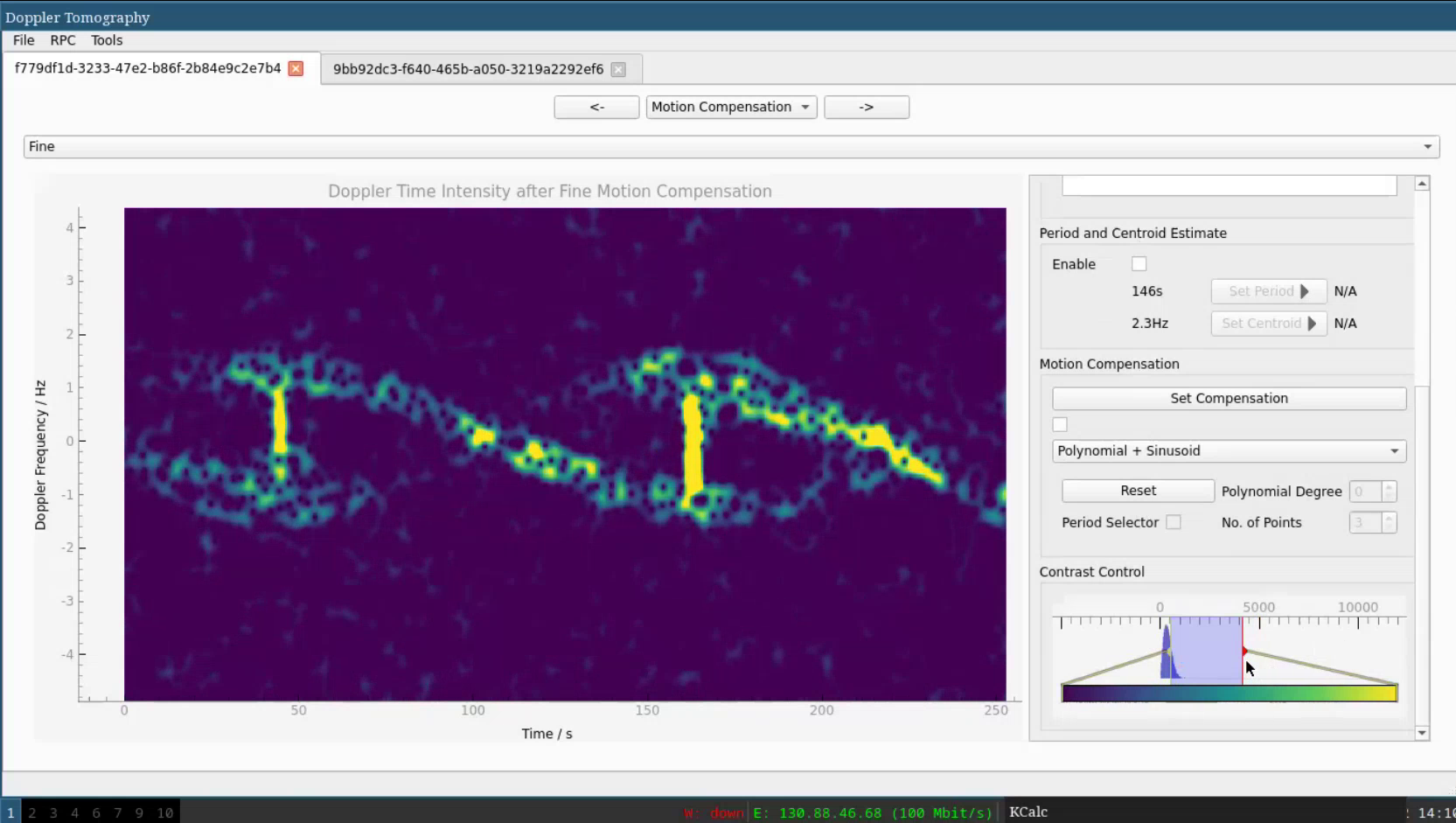
With a high enough bandwidth, one can create images using a technique called tomography, however, even with low bandwidth transmissions we can learn a surprising amount about what we are looking at. Above is the radar return from a tumbling rocket. The rotating/tumbling motion manifests in two sinusoidal patterns, one for each end of the rocket. As each end of the rocket moves towards and away from the observer, their Doppler shifts rise and fall creating sinusoidal patterns. Every time the rocket shows its broadside to the observer it creates broadband flashes that can be seen in the plot as bright vertical bars. From these two aspects we can determine how fast the object is rotating.
We can also get some idea of the size of the object and its axis of rotation. One sinusoid appears to fade behind the other. We can hypothsise that this is due to occlusion (one end passing behind the other from the observer’s point of view) indicating an axis of rotation close to perpendicular to the observer’s line of sight. The height of the sinusoids also indicate to us the (minimum) size of the object. The ends of larger objects move faster with the same rate of rotation and thus have a higher Doppler frequency.
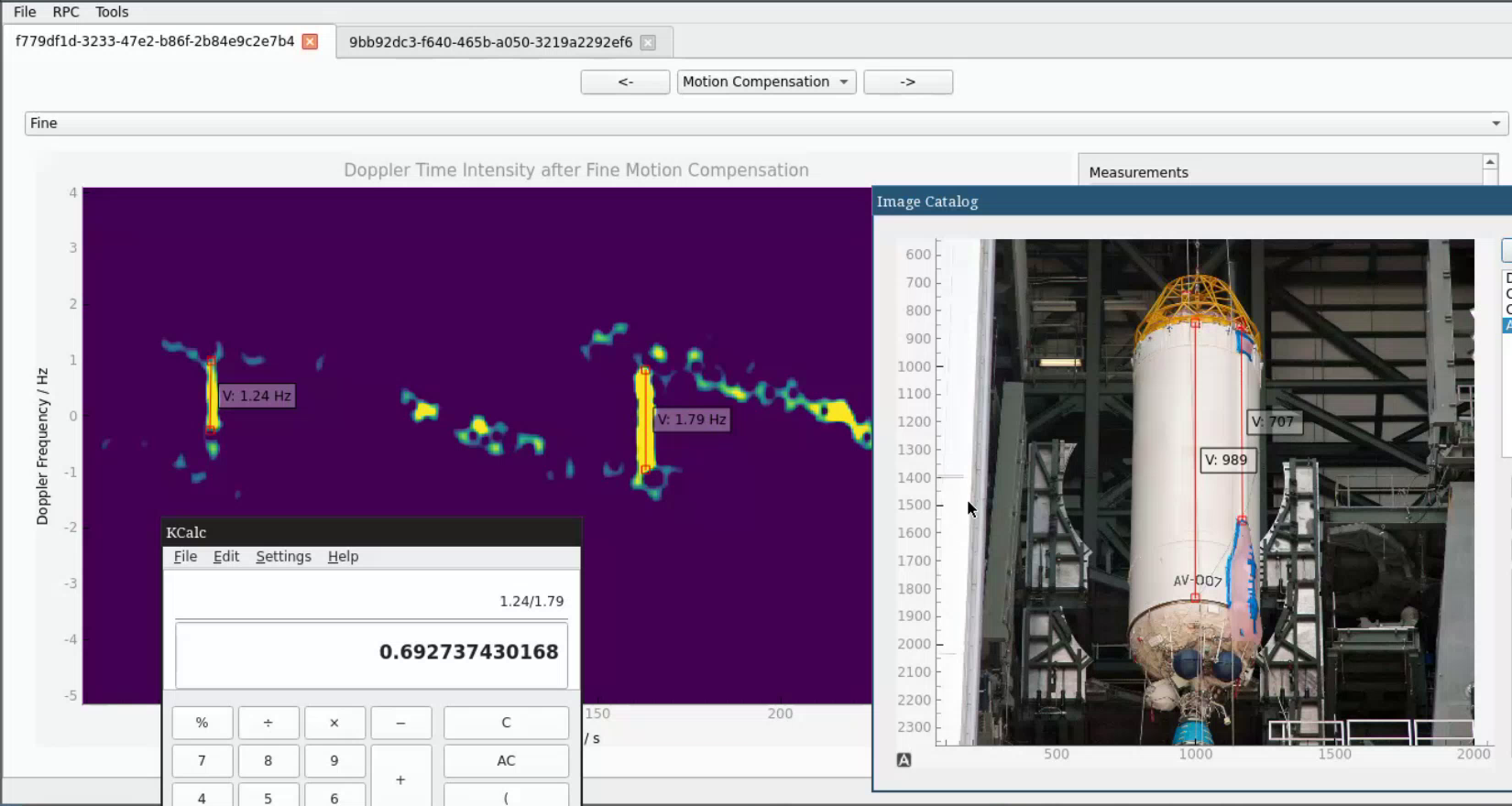
We can also gain some understanding of the shape of the object. Above is an example of comparing the bandwidth of two bright flashes with two features, the length of the fuel tank and hydrogen exhaust, on a reference image. Their ratios match! This is obviously not conclusive, the ratios could be a coincidence or due to another feature on the rocket, but we can find many such features in this image to build confidence in our identification. It also demonstrates how we can discriminate at resolutions beyond what is possible with an optical telescope, and this recording wasn’t even taken at a high bandwidth. Perhaps I will write a deeper a dive in the future.
Time Encoding
Time encoding is alternative approach to sampling where information is stored in the timings and not the ‘magnitude’ of a sample. It is partly inspired by how biological neurons exhibit behaviour that consists of bursts of electrical activity that are not (necessarily) synchronised.1 This is unlike typical samplers and digital circuits which operate to a clock.
My PhD thesis was on the topic of time encoding and the subject is of continuing interest to me. In particular, much of current research in time encoding overlaps significantly with sampling theory for non-uniform samples. I am interested in developing sampling theory that better captures the unique aspects of time encoded samples and isn’t just a mapping of time encoding to typical non-uniform samples.
Planning for Autonomous Platforms, Tracking, and Search
This a new topic for me as a research fellow at the University of Birmingham working with Beth Jelfs and Chris Gilliam. We’re interested in planning algorithms that can coordinate multiple autonomous platforms in the task of searching and tracking objects. The problem is very interesting for several reasons. For one, it requires optimising over multiple competing objectives. For example, acquiring a better track on one object usually requires a platform to look at a region it has already looked at before whereas to improve search efficiency the platform should want to look at regions it has not yet seen. Coordination of multiple platforms in such a task is also non-trivial. Communication links and bandwidth dictate how much information can be shared at any point in time. Most importantly of all, comprehensively searching the entire space of plans for a large number of cooperating platforms is largely intractable.
Individual neurons may not spike in a synchronised way but there are many situations where populations of neurons operate in some sought of synchrony↩︎